A note from the surgeon
Why I wrote this guide
When a man is diagnosed with prostate cancer, the first question should not be where to have surgery, but whether to have surgery. This guide starts there: what the alternatives are, and in which cases surgery makes sense.
If surgery is the right option, technique matters. I learned the lateral approach from its creator, Dr. Richard Gastón, who has been coming to ICUA to operate for seventeen years and still does. In 2023 we published both of our results together: there were no major differences between his and mine.
If you come to Madrid for surgery through this guide, I will be the one who operates on you, with my team at ICUA.
When I give a figure, I tell you where it comes from and which patients it refers to. The figures describe groups of patients; none of them describes your case yet.
Dr. Fernando Gómez Sancha · Urologist, Madrid
If you have an urgent symptom right now
You cannot pass urine, you are bleeding heavily or passing clots, you have a fever, chest pain, shortness of breath, a swollen leg or you are confused: go to your local emergency department. Do not send me an email; go to a hospital.
Start here
In one sentence
Radical prostatectomy removes the entire prostate with the tumor inside it. With the lateral approach, the robot reaches the prostate from one side, through a small window, without taking apart the structure that supports it at the front: the anterior pubovesical complex.
Put another way
We remove what has to be removed, and touch as little as possible of what you need to control your urine and keep your erections.
Before you decide
Surgery or not?
Not every prostate cancer needs immediate treatment, and surgery is not the only option. The decision depends on the risk of the tumor, on your age and health, and on what matters most to you. Before talking about technique, it is worth being clear about these three things.
1. Make sure the diagnosis is complete
To make a good decision, we need to know how much tumor there is, how aggressive it is and whether it is confined to the prostate. That usually means:
- Biopsy with the ISUP grade group (1 to 5, from least to most aggressive) and how many samples contained tumor. Ideally MRI-guided.
- Multiparametric MRI of the prostate. As well as helping with the diagnosis, it tells me where the tumor is and whether it comes close to the erectile nerves.
- Staging scans if the risk is unfavorable intermediate or high: PSMA PET, or CT and bone scan, depending on what is available.
| Gleason | ISUP grade group |
|---|---|
| 6 (3+3) | 1 |
| 7 (3+4) | 2 |
| 7 (4+3) | 3 |
| 8 (4+4, 3+5 or 5+3) | 4 |
| 9 or 10 | 5 |
The ISUP grade group indicates how aggressive the tumor is, but not the risk on its own: to classify the risk, the PSA and the findings on examination and MRI are also taken into account.
If anything is missing, we will tell you when we review your case. Sometimes it can be completed in Madrid before surgery.
2. Know the alternatives
| Option | Usually for | What it involves | Key trade-offs |
|---|---|---|---|
| Active surveillance | Low-risk tumors and some favorable intermediate-risk tumors. | No treatment up front. The cancer is monitored with PSA, MRI and repeat biopsies, and treated only if the tumor changes. | Avoids or delays the side effects of treatment. Requires sticking to regular check-ups. |
| Radical prostatectomy | Localized intermediate- or high-risk tumors, in men in good health with a long life expectancy. | The prostate and seminal vesicles are removed, and the whole specimen is examined. | At first, urine leakage and weaker erections, which improve over months. If radiotherapy is needed later, it is still possible. |
| External beam radiotherapy or brachytherapy | Intermediate or high risk, and men for whom surgery is less suitable. | Sessions over several weeks, or radioactive seeds. In intermediate or high risk it is usually combined with temporary hormone therapy. | Urinary and bowel symptoms; erections tend to worsen progressively. Operating after radiotherapy is more difficult. |
| Focal therapy | Very carefully selected cases, with a small, well-localized tumor. | Only the area of the tumor is treated, for example with focused ultrasound (HIFU). | Fewer side effects, but less long-term follow-up and a greater need for check-ups. |
In the large studies that compared surgery, radiotherapy and surveillance for localized tumors, long-term survival was very similar. What differs from one option to another is the type of side effects and how the disease is followed up. That is why the question is not only “which one cures more?” but “which one fits my tumor and my life best?”
3. Make sure someone has talked you through all of them
Before you decide, I recommend that you also talk to a radiation oncologist, in your country or here. If, after that, surgery is your choice, in this guide I explain how I do it.
The technique
What the lateral approach is
In the most widely used technique, the surgeon reaches the prostate from the front. In the lateral approach, developed by Dr. Gastón, the surgeon goes in from one side of the prostate, with direct access to the seminal vesicles.
- Two structures are preserved intact: the anterior pubovesical complex, which holds the bladder and urethra in place at the front like scaffolding, and the Santorini plexus (dorsal venous complex), a network of veins covering the front of the prostate.
- The blood vessels and nerves lying against the prostate are dissected with minimal use of thermal energy.
- In our series, the lateral approach was feasible in 90.5% of my patients. In the rest, because of the characteristics of the tumor, the prostate or the patient, a different approach was used.
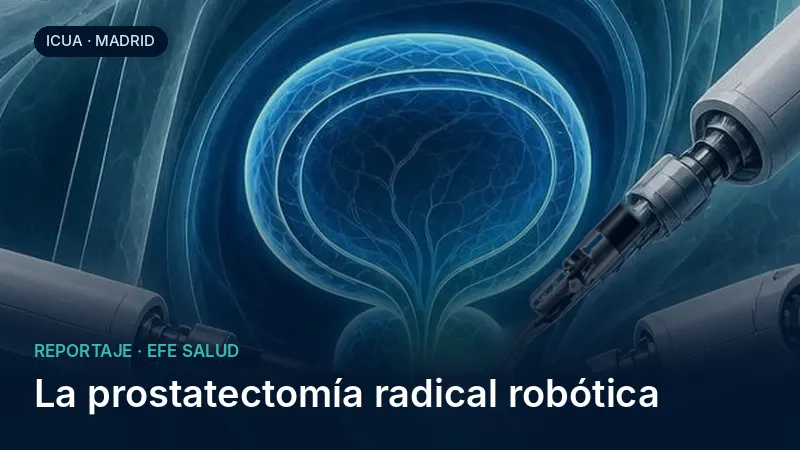
News report · EFE Salud
Removing the prostate to eliminate the cancer
A report by the EFE news agency on robotic radical prostatectomy (in Spanish). If you only watch one video, I recommend this one. Watch on YouTube.
Warning: contains real images of the removed prostate.
Television · TVE La 1
The surgical robot, explained on television
Interview on “La mañana” (TVE La 1) about robotic surgery (in Spanish). Watch on YouTube.
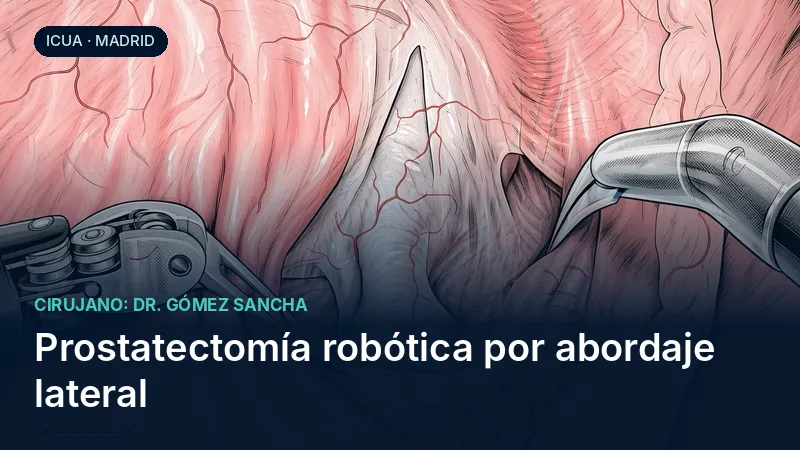
Surgeon: Dr. Gómez Sancha
How I operate using the lateral approach
Robotic radical prostatectomy using Gastón's technique, recorded at ICUA. Watch on YouTube.
Warning: surgical video, with real images of the inside of the body during the operation. Watch it only if you want to see the details.
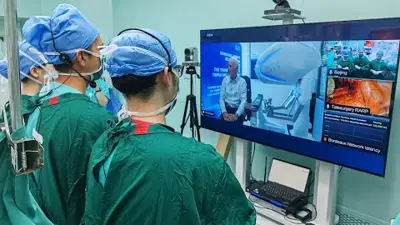
Surgeon: Dr. Gastón · Assistant: Dr. Rodríguez Socarrás
Transcontinental surgery: the surgeon in Europe and the patient in China
Remote robotic prostatectomy, with Dr. Gómez Sancha interviewing both surgeons. Watch on YouTube.
It is a demonstration of how far the technology can go. Your operation in Madrid is not remote: the surgeon is in the same operating room as you.
Why the lateral approach better protects the erectile nerves
Simplified diagrams, not to scale.
2Conventional approach, in cross-section. The nerves are not just two cords at the back (the neurovascular bundles): they form a veil of fibers around the prostate, and the ones at the front head to the erectile bodies of the penis (corpora cavernosa). Working from the front, the prostate comes out upward, taking the Santorini plexus and those anterior fibers with it (top right); the posterior fibers are preserved. 3Lateral approach. The surgeon enters through the anterolateral surface, and the dissection proceeds close against the prostate capsule, inside the veil of nerves. The Santorini plexus and the anterior fibers are not touched. 4At the end. The prostate comes out of its bed through that same anterolateral window, and the ring of nerves and vessels is left complete. How much can be preserved always depends on the extent of the tumor, which is assessed before and during the operation.
Results
What our published results show
These are my 224 patients operated on with the lateral approach between January 2015 and March 2021, with a mean follow-up of about 4.7 years1. Results from our center
How to read these figures
They include only the patients in whom the lateral approach could be performed. Men who needed radiotherapy afterward are not counted in the continence figure, and men who already had erectile dysfunction before surgery are not counted in the erection figure.
A positive margin does not mean the cancer will come back. Some positive margin was found in 37.9%, almost always focal; the one that matters most for prognosis is the significant margin.
Other reports from our group, using different definitions, give different figures. Here we use the full published study.
| Outcome | Dr. Gastón (n = 289) | Dr. Gómez Sancha (n = 224) |
|---|---|---|
| Continence at catheter removal | 86% | 85% |
| Continence at one year | 96% | 98% |
| Erections at one year | 73% | 72% |
| Significant margin (> 2 mm) | 5.9% | 7.6% |
| Biochemical recurrence | 11.7% | 12.0% |
Traveling to Madrid
The journey, step by step
You write to icua@icua.es with no attachments and send your reports via SwissTransfer, password-protected.
Biopsy with ISUP grade group, MRI, PSA, and staging scans if you have had them.
The team checks that the documentation is complete, and we assess whether surgery is reasonable.
Do not buy tickets until you have provisional dates.
Consultation, pre-operative tests, surgery and a hospital stay of 2 to 3 days.
You can stay until we remove the catheter, between days 7 and 10, or go home with it. More on this below.
Pathology report, PSA and follow-up with your urologist, to whom we send a full report.
If radiotherapy were needed afterward, it would normally be done in your own country.
Leaving the hospital with a catheter
After the operation you will have a bladder catheter for a few days, while the junction between the bladder and the urethra heals. You leave the hospital with it, connected to a small bag strapped to your leg, under your trousers.
There are two options:
- Stay in Madrid until we remove the catheter, between days 7 and 10, and check how you urinate before going home.
- Go home with the catheter and have your urologist remove it on the date we give you. Traveling with the catheter secured to your leg is quite safe.
Before discharge we show you how to manage it and give you what you need:
- Keep the bag below your bladder at all times, and the catheter secured to your thigh so that it does not pull.
- Empty it when it is half full, before a long journey and before boarding.
- At night, a larger bag is connected.
- Drink water regularly. On the plane, an aisle seat is best.
- Carry spare bags and your discharge report, with the catheter removal date, in your hand luggage.
Some men, especially younger ones, already have nighttime erections during the days they have the catheter. They can be uncomfortable, but they are normal and nothing needs to be done. When the nerves have been preserved, they are usually a good sign.
When to seek urgent help
If urine stops draining and your belly feels swollen or painful, if you have a fever or chills, if you are bleeding heavily or passing clots, or if the catheter comes out: go to your local emergency department.
Planning your stay
Traveling for surgery raises questions that a technical explanation does not settle: which reports to send, how long to stay, when it is safe to fly, who helps you if something happens once you are home. This is how we organize surgery for patients from outside Spain. It is not a fixed package, and it does not replace a plan made for you.
Option A
Stay until the catheter is removed
10 to 12 days in Madrid
You arrive one or two days before surgery, the hospital stay lasts 2 to 3 days, and the catheter is removed between days 7 and 10. We check how you urinate before you go home.
Keep in mind: more nights of accommodation.
Option B
Go home with the catheter
About 4 or 5 days in Madrid
You arrive one or two days before surgery and can fly as soon as we discharge you, after 2 or 3 days, with the catheter secured to your leg. Your urologist removes it on the date we give you.
Keep in mind: the appointment with your urologist needs to be arranged beforehand.
Start at home: pelvic floor exercises
Continence comes back sooner if the muscle that closes the urethra is trained. Ideally, start a few weeks before the operation, because doing the exercises properly is not as easy as it seems: many men squeeze their buttocks, abdomen or thighs instead of the pelvic floor.
- To find the muscle, imagine you are holding in gas or stopping your urine stream. Use this only to identify it: do not practice by actually stopping the stream.
- Contract without moving your buttocks or holding your breath, hold for a few seconds, then relax completely.
- If you have access to a physical therapist who specializes in the pelvic floor, one or two sessions before surgery will help you do it correctly.
In Madrid we go over them with you before surgery.
Send the right information
Biopsy report with the ISUP grade group and the number of samples with tumor · multiparametric MRI (the report and, if possible, the images) · PSA history · staging scans if you have had them · medication and allergies, especially anticoagulants and antiplatelet drugs · relevant medical conditions and problems with previous anesthesia · previous abdominal surgery, hernias or prostate treatments · how you urinate and what your erections are like now · what your priorities are.
Do not send reports by ordinary email or social media. In the case review section I explain how to do it securely.
Initial review and consultation
First we check that the documentation is complete. Then I assess whether surgery is reasonable in your case and whether any test is missing. This first look is orientation, not a diagnosis, and it is covered by professional secrecy.
You should come out of the consultation knowing: whether surgery is a good option compared with the alternatives, what I expect to be able to do with the erectile nerves, and whether lymph nodes will need to be removed; and with a written quotation and the estimated time in Madrid.
Organize the trip
Do not buy non-refundable tickets until we confirm provisional dates. If you stay until the catheter is removed, plan on 10 to 12 days in Madrid; if you go home with it, about 4 or 5 days.
Plan for: a companion, at least for the first few days · accommodation near the clinic, with an elevator · your usual medication · your insurer's limits for planned surgery outside your country · incontinence pads for the days after the catheter comes out · some leeway in case your hospital stay runs longer.
In-person assessment in Madrid
One or two days before surgery we review your tests, carry out the pre-operative assessment and sign the informed consent. We talk calmly about which nerves I expect to preserve, about continence and erections, about how to manage anticoagulants, and about what would happen if something unexpected comes up in the operating room.
We go over the pelvic floor exercises with you, to check that you are doing them correctly.
Surgery and hospital stay
The hospital stay is usually 2 to 3 days. Before discharge you receive: a discharge report · instructions for the catheter and your medication · compression stockings and heparin injections for one month, to prevent thrombosis · warning signs and a 24-hour emergency contact · when the pathology report will be ready.
Recovery in Madrid
It is normal to feel tired, to have some discomfort in the small incisions on your abdomen, shoulder pain in the first few days from the laparoscopy gas, some swelling of the scrotum or penis, and a little blood in the urine or around the catheter when you have a bowel movement.
We decide when you can leave Madrid: a flight you have already booked should not outweigh a fever, bleeding or a problem with the catheter.
Catheter removal and the flight home
When the catheter comes out, it is normal to leak some urine, especially when you cough or stand up. Keep doing your pelvic floor exercises and wear pads.
When flying, especially on long flights: drink water, get up and walk every hour, wear your compression stockings and do not skip your heparin injection. Keep medication, reports and emergency contacts in your hand luggage.
Follow-up once you are home
It does not end when you board the plane. When the pathology report is ready, I explain it to you in a video consultation. The first PSA test is done at six weeks and should be undetectable. Together we follow your continence and erections over the first few months.
With your consent, we send a full report to your urologist at home, who will be the one following you closely.
After the operation
What the pathology report looks like
A few weeks after the operation, the pathology report arrives: the study of the entire prostate under the microscope. It is the most important document in your follow-up, because it tells us what the tumor was really like, and that does not always match what the biopsy and the MRI showed. I will explain it to you in a video consultation, but it helps to know what you will find in it.
The tumor map
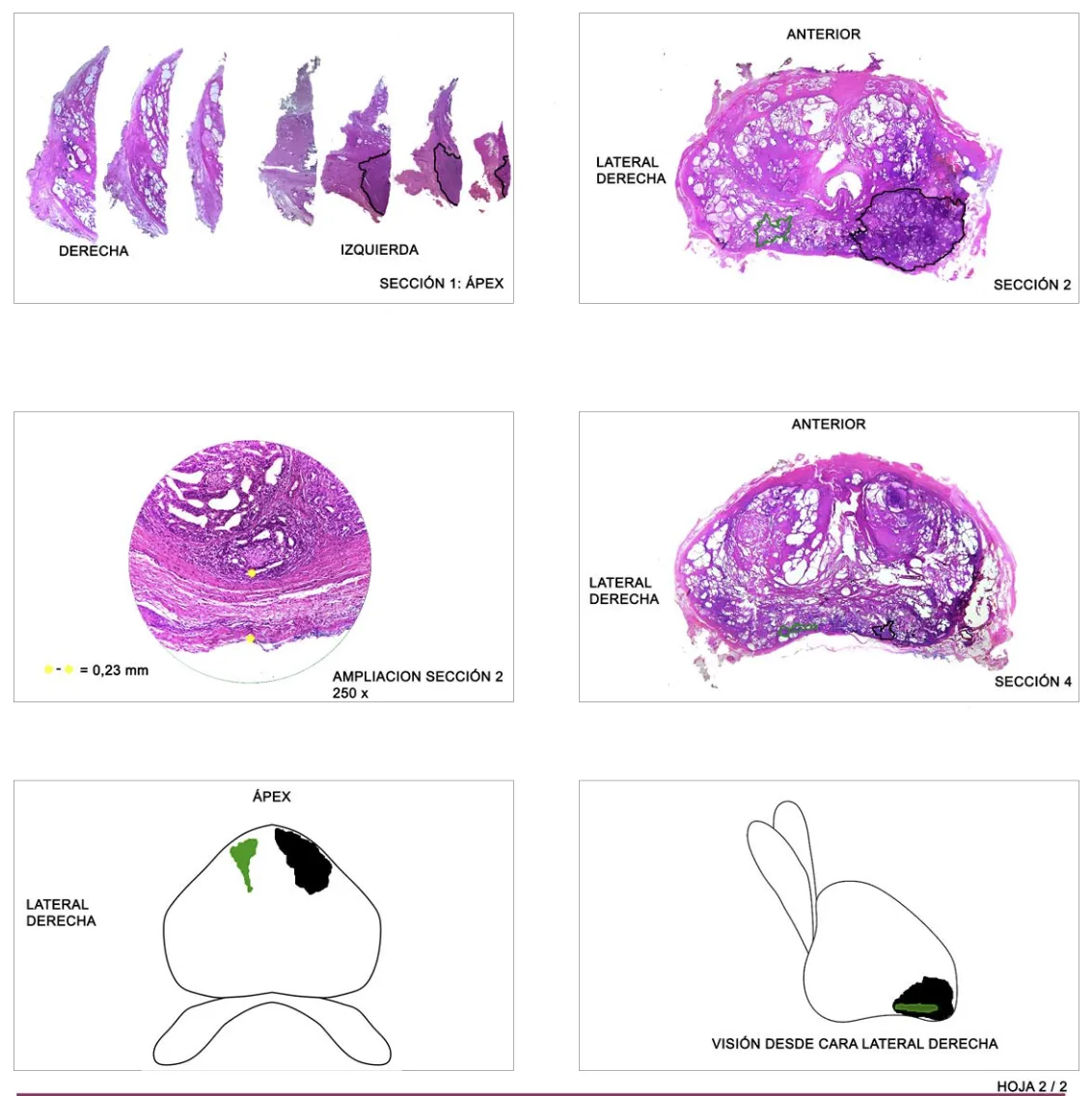
The pathologist cuts the entire prostate into slices, from the apex (the tip, next to the sphincter) to the base (next to the bladder), and examines each whole slice under the microscope (whole-mount sections). This makes it possible to map where the tumor is and to measure how close it comes to the edge. These images are from a real, anonymized report. In the diagrams, the patient's right side appears on the left of the image, as on a scan.
 AB
CD
EF
AB
CD
EF- AThe apex, cut into thin sections. It is the most delicate area for continence, and the pathologist examines it separately with special care.
- BA whole slice. The front (anterior) surface is at the top and the back (posterior) surface at the bottom, next to the rectum. The colored lines outline the tumor foci; when there is more than one, each focus has its own color.
- CThe close-up. Before the prostate is sliced, its entire surface is painted with ink. Under the microscope, the distance between the tumor and that ink, which marks the edge of the specimen, is measured. That measurement decides whether the margin is positive or negative.
- DAnother slice, closer to the base. Following the slices, you can see how the size of each focus changes along the length of the prostate.
- EThe overall map. It combines all the slices into a single drawing and shows where each focus is, with the seminal vesicles at the bottom.
- FThe prostate seen from the side. It helps you understand at what level and on which surface each focus lies.
What the text says
Besides the images, the report includes a description and a diagnosis. These are the sections worth understanding.
- 1Specimen and description. What was examined (the prostate with the seminal vesicles and, if they were removed, the lymph nodes), its size and its weight. The weight is that of the prostate, not of the tumor.
- 2Gleason score and ISUP grade group: aggressiveness. The Gleason score adds together the two most common patterns in the tumor, each graded from 3 to 5. Today it is summarized as the ISUP grade group, from 1 (least aggressive) to 5. If there are several foci, each one is described, and the prognosis is set by the most aggressive. It is not unusual for the grade in the surgical specimen to differ from the grade in the biopsy.
- 3Margins. If the tumor touches the ink, the margin is positive; if not, it is negative, and sometimes the report states how far away the tumor is. A positive margin does not necessarily mean that tumor has been left behind: we explain this in the FAQ.
- 4Extension outside the prostate. States whether the tumor has gone through the capsule that surrounds the prostate and whether it involves the seminal vesicles.
- 5Perineural and vascular invasion. Perineural invasion (the tumor growing along small nerves inside the prostate) is common and does not mean the tumor has spread outside the prostate.
- 6Lymph nodes. How many were examined and whether any of them contain tumor.
- 7The pTN stage. The final summary. The “p” means it is based on the surgical specimen. pT2: the tumor is confined to the prostate. pT3a: it has extended outside the prostate to a limited extent. pT3b: it involves the seminal vesicles. N0: lymph nodes free of tumor; N1: at least one lymph node involved.
And then what?
The report, together with the PSA at six weeks, which should be undetectable, determines your follow-up. In most cases, monitoring PSA is enough. When the tumor is more aggressive or has extended outside the prostate, we will discuss whether to monitor closely or to add radiotherapy. We will go through your report together.
Questions
Frequently asked questions
Who will operate on me?
I will, Dr. Gómez Sancha, with my ICUA team. I learned the technique from Dr. Gastón, who still comes to Madrid to operate.
How long will I have the catheter?
In our series it was removed between days 7 and 10 after the operation.
Will I get my erections back?
For many men this is the question that weighs most, and the answer depends mainly on three things: what your erections were like before surgery, your age, and whether the erectile nerves, which run close against the prostate on both sides, can be preserved.
Preserving those nerves depends on the tumor, not just on the technique. If the cancer is close to them, the priority is to remove it completely, and I may have to sacrifice the nerve on that side. In my series I was able to preserve both in 73% of patients1. We will discuss this before the operation, with your MRI and biopsy in front of us.
Recovery is slow. The nerves suffer even when they are preserved, and erections usually come back gradually over months, sometimes up to one or two years. Among men with good function before surgery, 66% were able to have intercourse at 3 months and 72% at one year, with or without pills such as sildenafil or tadalafil1.
In the meantime, this is not about waiting and doing nothing. Even when the nerves have been preserved, handling them during the operation leaves them “stunned,” and for weeks or months they do not send their signals properly. To keep the tissue of the penis from losing elasticity and blood supply while they recover, after the operation we prescribe a rehabilitation program with tadalafil and a vacuum pump. We will explain how to use them.
If that is not enough, there are other options, such as penile injections; if erections do not come back in the end, there is the option of a penile prosthesis.
Some things always change, and it is better to know them beforehand:
- There will be no ejaculation. Orgasm is preserved, but it is dry, because the prostate and seminal vesicles are removed.
- You will no longer be able to father children naturally. If this matters to you, sperm can be frozen before the operation.
- Some men notice a few drops of urine leaking at orgasm, or that the penis seems somewhat shorter. This usually improves with time.
What if the margin is positive?
It is the first thing that frightens men when they read the report, because it sounds like “they didn't get it all.” Often, that is not the case.
Think of peeling an orange with a thin knife, trying not to touch the segments. Before examining the prostate, the pathologist paints its entire surface with ink; that surface would be the orange peel. If tumor cells are found touching that ink, the margin is positive. That describes the specimen on the table, not what is left inside you: there may be disease left behind, but it is also possible that the cut went through the tumor and the rest came out whole with the prostate. The report cannot tell these apart.
What does tell them apart is PSA. Without a prostate, PSA should fall to undetectable levels within a few weeks. If it stays that way, there is no active prostate tissue; if it starts to rise again, it warns us months before any symptom appears.
That is why, with a positive margin, radiotherapy is not given straight away in most cases. Three large trials compared radiotherapy given right after surgery with monitoring PSA and treating early if it rose, and they did not find that treating up front was better4. It did, however, cause more problems with continence, bowel function and erections. With monitoring, most men never needed radiotherapy.
Monitoring works only if you keep to it. We will tell you when to have your PSA tests, and it is important not to skip any, even if you feel perfectly well: salvage radiotherapy works better the lower the PSA is when it starts5.
There are different situations, which we discuss case by case: if PSA does not become undetectable after the operation, or if the tumor was very aggressive, invaded the seminal vesicles or involved the lymph nodes.
In our series, the margin was positive in 37.9% of cases, almost always focal, and significant (more than 2 mm) in 7.6%1.
Case review
If you would like us to review your case
First contact
Write to icua@icua.es without attaching any documents. The team replies within 24 to 48 hours and tells you how to send your reports securely.
What to have ready
- Biopsy report, with the ISUP grade group.
- Multiparametric MRI.
- PSA history.
- Medication and relevant medical conditions.
Go deeper
Full-length surgical videos and references
Complete, unedited operations recorded at ICUA. They are intended for professionals, but also for patients who want to see the real operation.
Warning: these are surgical videos with explicit images of the inside of the body.
Surgeon: Dr. Gómez Sancha
Robotic radical prostatectomy using Gastón's technique
Lateral approach with preservation of the anterior pubovesical complex. Watch on YouTube.
Surgeon: Dr. Gastón · Assistant: Dr. Gómez Sancha
Robotic radical prostatectomy with lateral access
Surgery by the creator of the technique, at ICUA. Watch on YouTube.
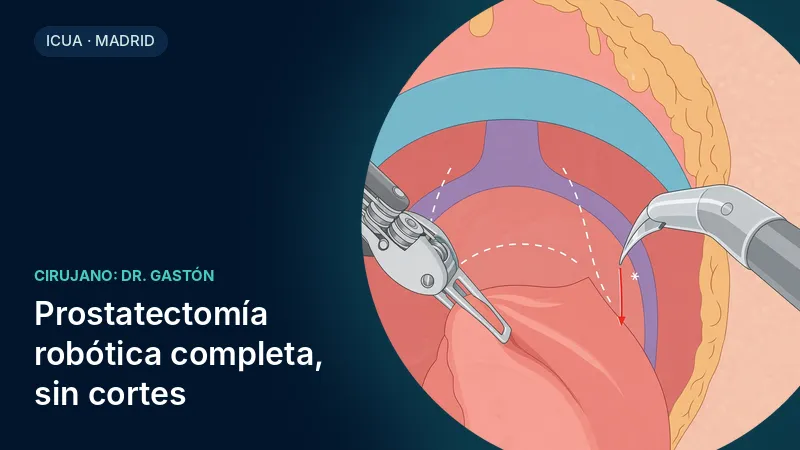
Surgeon: Dr. Gastón
Full length robotic radical prostatectomy, lateral approach
Complete, unedited surgery. Watch on YouTube.
More videos in the playlist Cirugías Robóticas Da Vinci (da Vinci robotic surgeries) on Dr. Gómez Sancha's channel.
References
- Rodríguez Socarrás M, Gómez Rivas J, Reinoso Elbers J, et al. Robot-Assisted Radical Prostatectomy by Lateral Approach: Technique, Reproducibility and Outcomes. Cancers 2023;15:5442. doi:10.3390/cancers15225442
- Reinoso Elbers J, Rodríguez Socarrás M, et al. V12-06 Robot assisted radical prostatectomy by complete lateral access with preservation of the pubovesical complex. J Urol 2021;206(3S). Video.
- Reinoso Elbers J, Rodríguez Socarrás M, et al. V07-08 Feasibility and clinical outcomes of robot-assisted radical prostatectomy by lateral approach. J Urol 2022;207(5S). Video.
- Vale CL, et al. Adjuvant or early salvage radiotherapy for the treatment of localised and locally advanced prostate cancer: a prospectively planned systematic review and meta-analysis of aggregate data (ARTISTIC). Lancet 2020. doi. Included trials: RADICALS-RT (Parker CC, et al. Lancet 2020; Ann Oncol 2024), RAVES (Kneebone A, et al. Lancet Oncol 2020) and GETUG-AFU 17 (Sargos P, et al. Lancet Oncol 2020).
- Tendulkar RD, et al. Contemporary update of a multi-institutional predictive nomogram for salvage radiotherapy after radical prostatectomy. J Clin Oncol 2016. doi